A veterinary duo built what coding agents lacked: structural vision, durable intent, and a mouth that posts — with daily proof and a list of what still fails.loct impact · aicx search · /vc grok send · vc justdo
02 · THE SURFACEREAL USAGE · VC-FRAME02 · DWG VC-002
Where you watch the work.
vc-frame is the terminal you sit in. vc-server is the same run list in a browser.
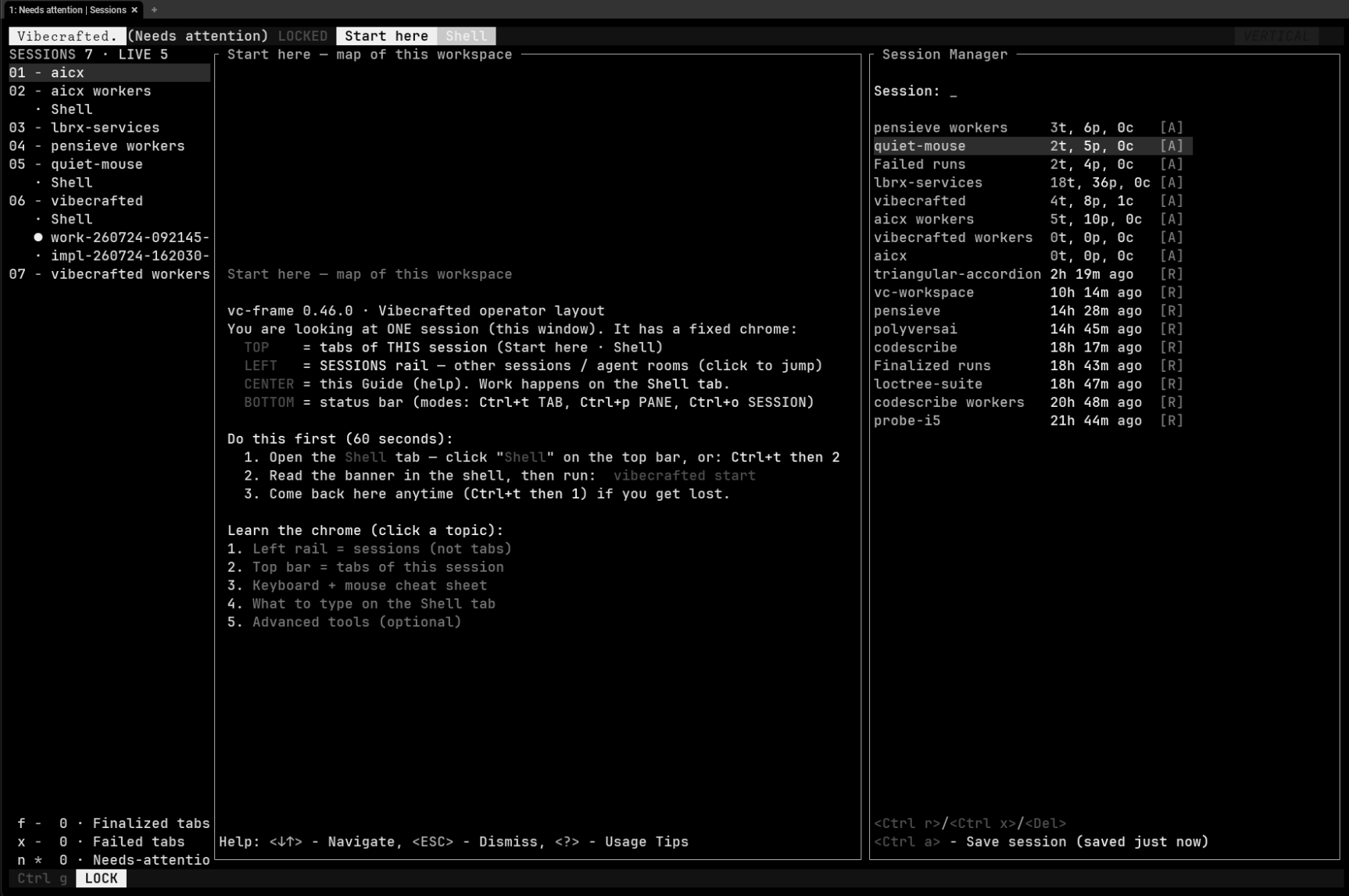
Needs attention · Sessions — vc-frame
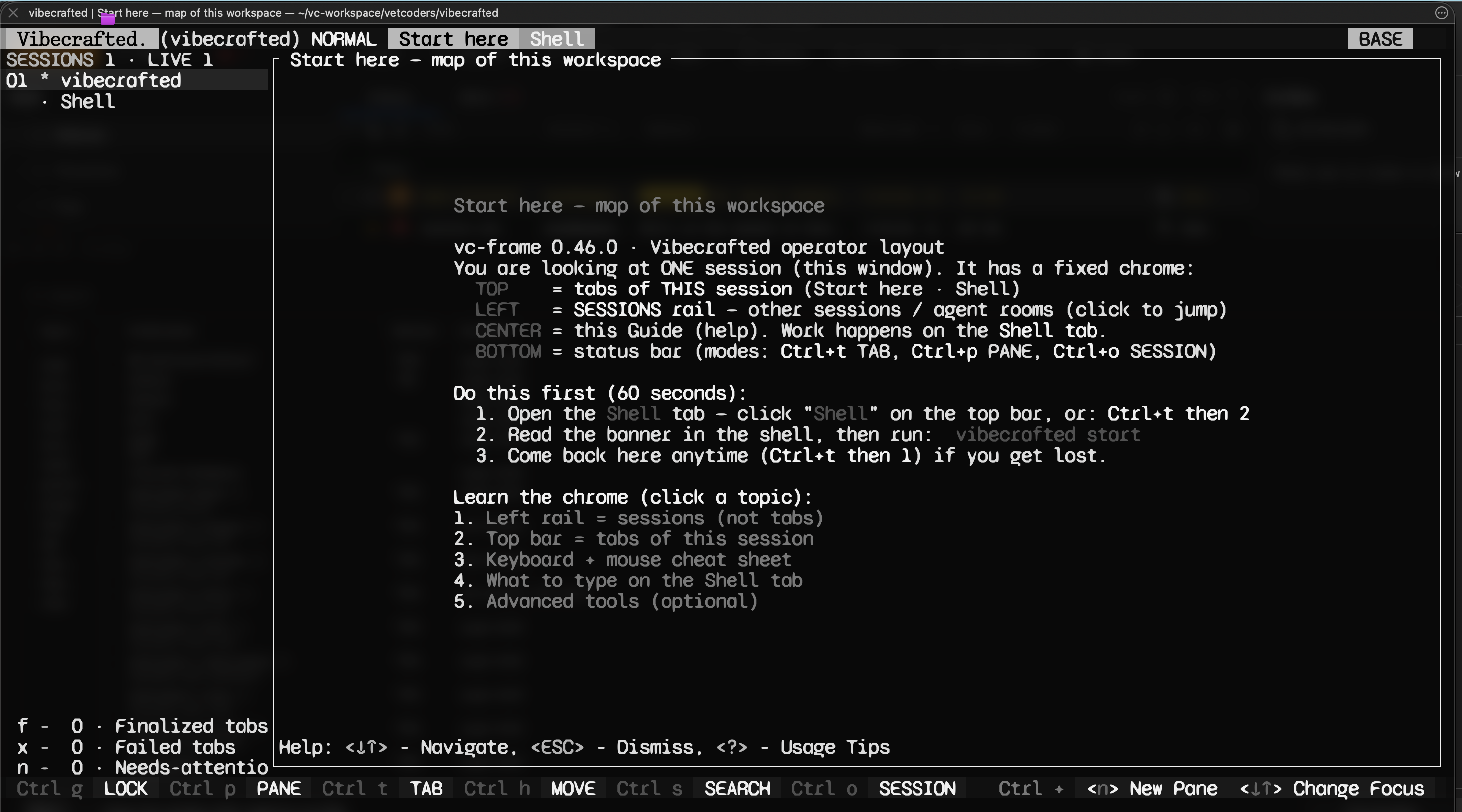
Start here · chrome legendFirst minute: where sessions live, where work happens, how Session Manager attaches. Inventory of rooms — not fleet truth.
OPERATOR MAPstart-here
Needs attention · Sessions — vc-frame
Start here · chrome legendFirst minute: where sessions live, where work happens, how Session Manager attaches. Inventory of rooms — not fleet truth.
FINALIZED RUNfinalized-run
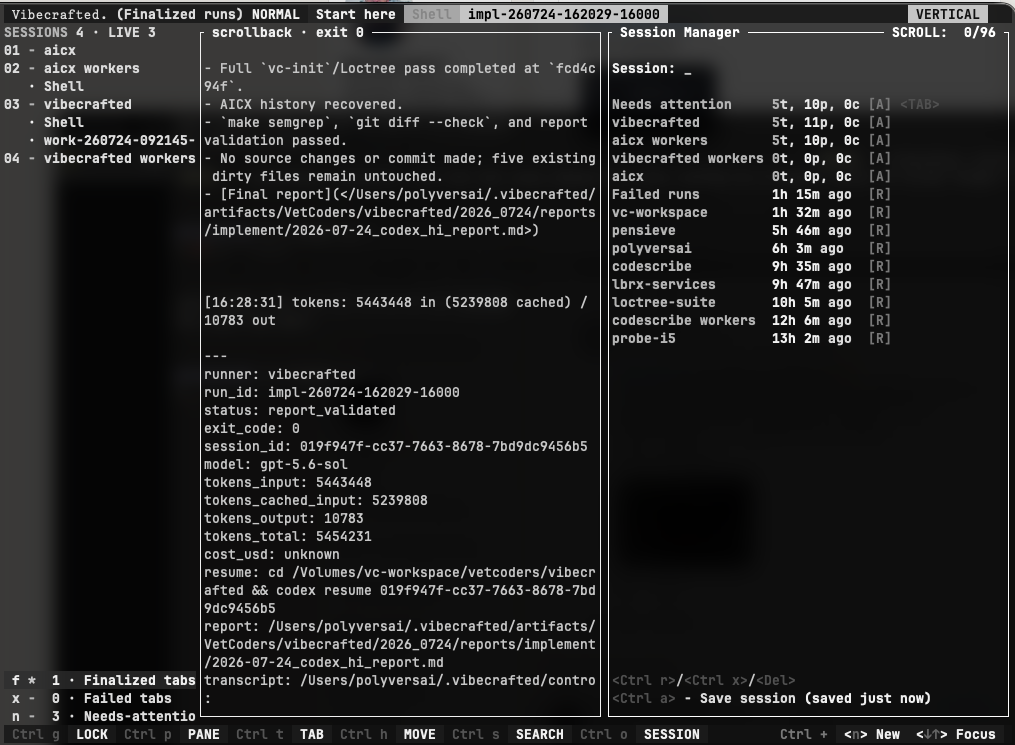
Vibecrafted. · Finalized runs
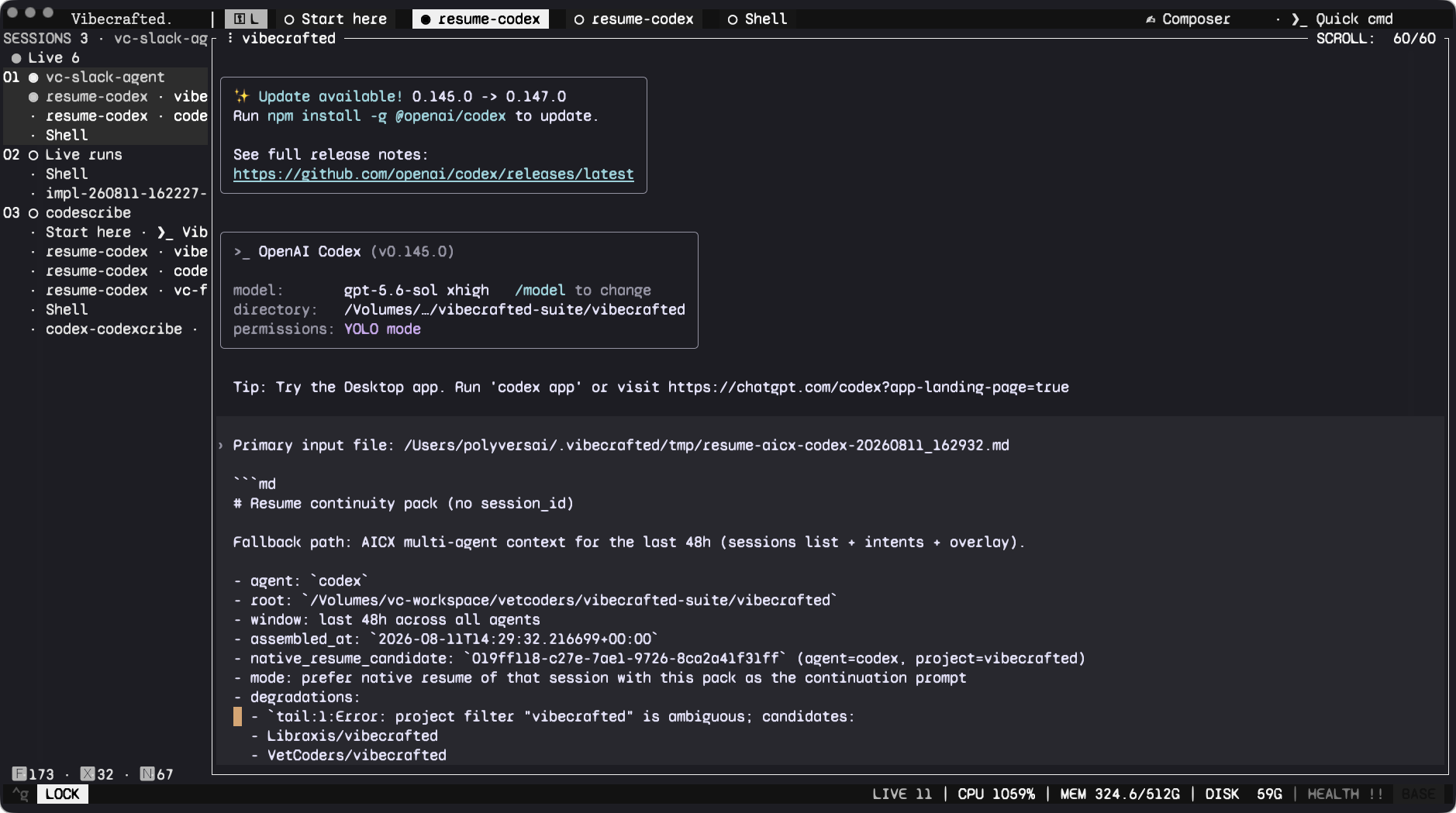
Report · tokens · resumeA settled run leaves a report, token counts, and a resume path. Settlement strip (f · x · n) lives with the board — not as decoration.
CONTROL PLANEcontrol-plane
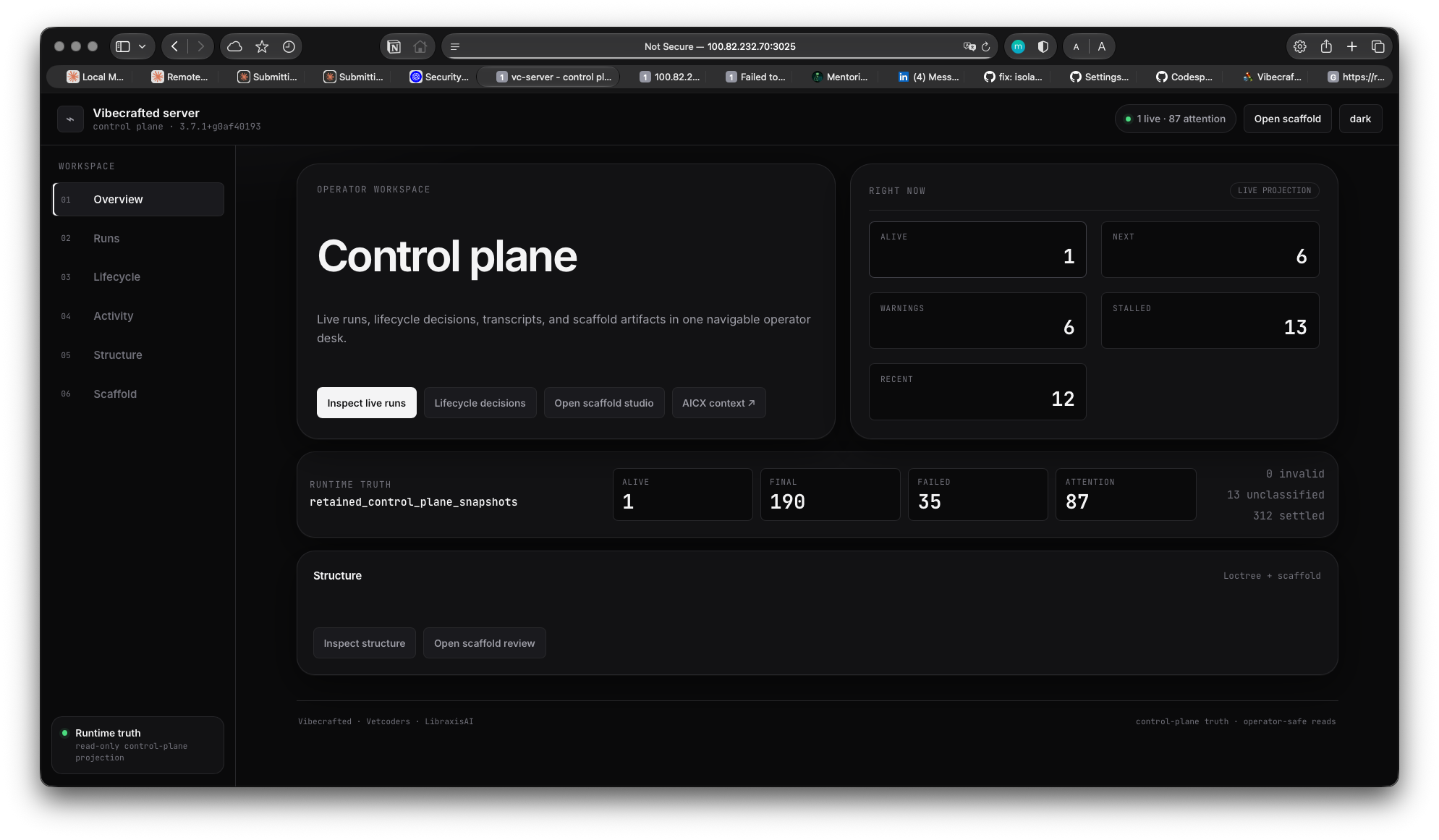
Vibecrafted server · control plane
Operator desk · runtime truthvc-server in the browser: live runs, lifecycle decisions, transcripts, and scaffold artifacts over the same control plane the CLI writes. Read-only projection — alive / final / failed / attention come from retained snapshots, not from a dashboard's imagination.
COCKPITcockpit
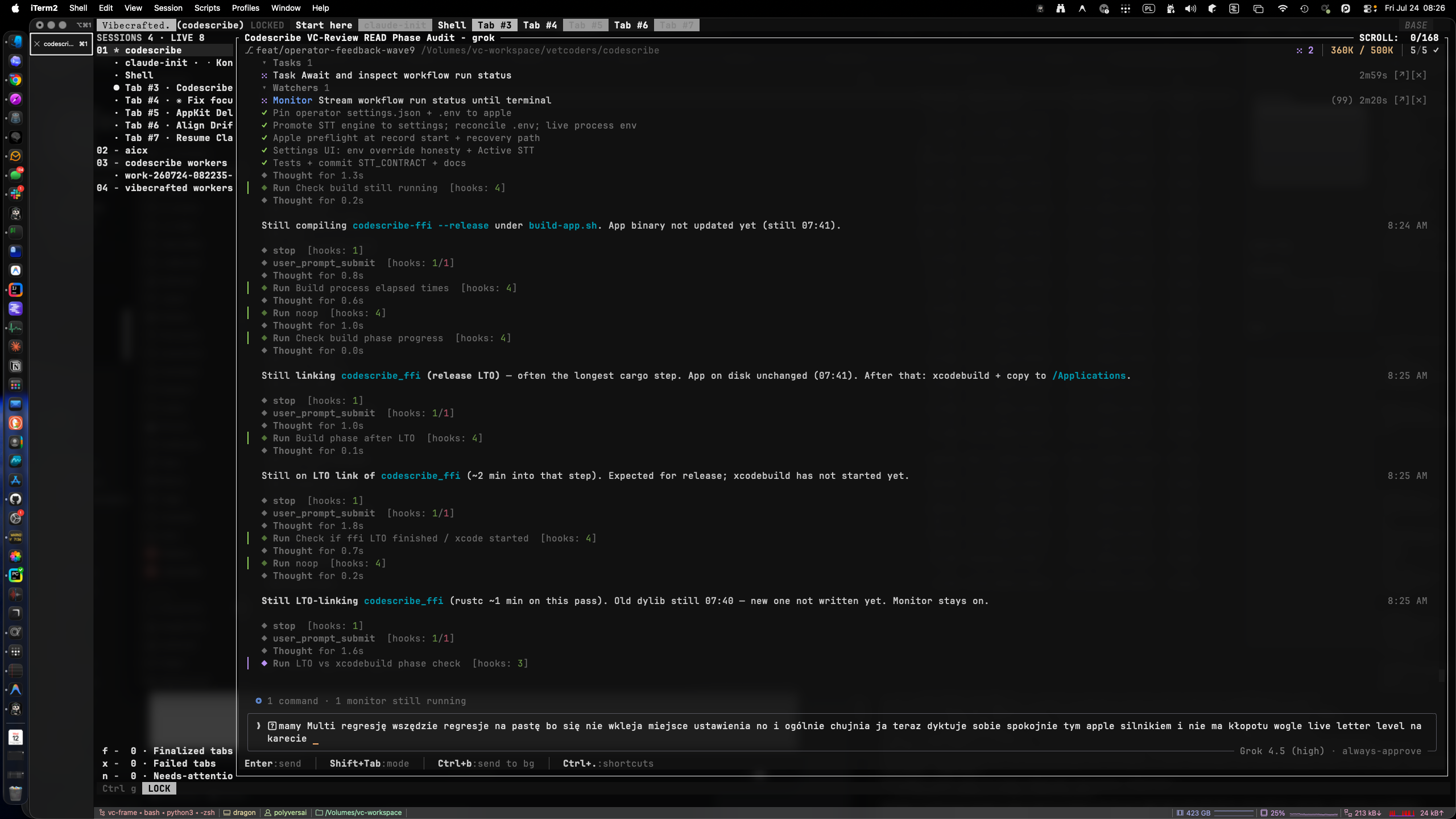
vc-frame · dispatch layout
Dispatch layout · multi-panePeer agents side by side inside one window. The rail jumps sessions; tabs stay local to the room you are in.
ANATOMYanatomy
vc-frame · anatomy
Rail · tabs · panesFixed chrome: left sessions, top tabs, center work, bottom status. Learn it once — every layout uses the same bones.
03 · WHAT YOU INSTALLSIX COMPONENTS · ONE CONTROL PLANE03 · DWG VC-003
What lands on your machine.
One installer. Six binaries. They all read and write the same directory.
vibecrafted
CLI · runtime
The runtime and the launchers. vibecrafted <skill> <agent> dispatches real work to claude, codex, gemini or junie, records every run in the control plane, and settles it as f / x / n with receipts — report, transcript, seal.
loctree
CLI + MCP · Rust
Structural perception. Repo map, dependency slices, consumers, blast radius, dead code — the map an agent reads before it touches your code.
aicx
CLI + MCP · session memory
Parses agent transcripts — Claude, Codex, Gemini — into a searchable intent store. What was decided, by whom, and why: retrievable, not folklore.
vc-frame
terminal cockpit · Rust
The operator terminal (a hard fork of Zellij): session rail, live-run chips, command composer, paste stack. Where you watch the fleet work — and interrupt it.
vc-server
web control plane · Rust
A read-only browser projection of the same control plane the CLI writes: live runs, lifecycle decisions, transcripts, scaffold review. Leptos SSR + axum. It observes; it cannot mutate your repo.
vc-slack
Slack connector · OAuth + MCP
Agency on your Slack, self-hosted. Agents post, reply, react, DM and hand off to each other in bounded threads — under operator-controlled scopes, with tokens that never leave your side.
01 · ABOUTFOUR CUTS MISSING01
Agents write. The same four things are missing every time .
Generation gets you a diff. It does not get you sight, memory, a mouth, or a verdict. That is the hangover — the session that cannot say what it touched, why, or whether it shipped. Here is what we keep finding in agent-run repos.
No sight
loct impact never ran. Blast radius is a vibe. Deletes land on importers nobody mapped. Structure is guessed after the cut, not before.
No memory
Intent dies at compaction. The next session re-derives what aicx would have kept as typed memory. Chat residue is not a handoff.
No mouth
Status lives in Slack paste. Tokens in the browser. /vc never sent. The projector is treated as the log.
No proof
Green CI, red product. Gates skipped, receipts missing, ship as a feeling. Sprawczość is a list of what still fails — not a badge.
02 · ENGINEERINGAXIOMS · METHOD02 · DWG VC-002
Less magic More inspectable work .
The vocabulary can stay vivid, as long as the system remains inspectable: context before edits, evidence after runs, and a release surface that says what is still uncertain.
Models drift when they write into a repo blind. Structural maps give the session landmarks before the agent touches a file.
Operational consequence
Loctree and adjacent structural maps turn the repo into navigable terrain before edits start.
The agent works against named files, blast radius, and symbol topology instead of drifting through grep haze.
That lowers false confidence: if the structure disagrees with the prompt, structure wins.
Code generation is noisy. The Marbles loop gives that noise a place to show up: small loops, counterexamples, and visible unresolved work.
Operational consequence
One run is not evidence. The loop keeps cutting the highest-risk lie until the runtime surface agrees with the promise.
Early loops remove structural falsehoods; later loops compress roughness into a calmer, more repeatable product shape.
The target is not "nice output" but a state where P0/P1/P2 issues converge toward zero.
Structured Human-AI collaborative engineering. The craft is in the handoff: humans keep scope, taste, and irreversible decisions; agents do fieldwork with evidence attached.
Operational consequence
Humans do not compete with the model on typing speed; they own scope, truth checks, and irreversible decisions.
Agents get room for deep fieldwork, but gates, review artifacts, and runtime proof keep the final shape accountable.
That is why the product can feel vivid without becoming mystical: the craft stays inspectable.
03 · THE SHIFTVIBES → VECTORS03 · DWG VC-003
Most AI coding sessions leave fragments. Vibecrafted gives the work coordinates.
Without a board
01
Context evaporates.
The next session may inherit a diff, but not the reason behind it. The repo has changes; the work has no memory.
02
Retry becomes the method.
A green build starts to feel like proof. It is useful signal, but not enough to know whether the product is safe.
03
Done stays blurry.
Artifacts collect in comments, branches, notes, and screenshots. A future agent can see pieces, but not the shape.
→
With a board
01
The contract is visible.
Scope, owner, evidence, and next action sit on the same surface before the agent starts cutting.
02
The trail survives.
Reports and artifacts stay attached to the repo, so the next session can continue from evidence instead of mood.
03
Convergence is inspectable.
The board does not declare victory. It shows what landed, what moved, and what still asks for a decision.
•05PHASES
•06OPERATORS
•01SHARED BOARD
•00LOST CONTEXT
04 · THE FRAMEWORKMAP → PROVE04 · DWG VC-004
Not a rewrite. A cadence. Map · Remember · Craft · Wire · Prove.
Five phases, four cuts of the same truth. Loctree maps before the edit. Aicx remembers after compaction. Agents ship under gates. vc-slack is the mouth — Slack is a projector. Marbles settle only what those four already made true. Green CI is not a product verdict.
01
Scaffold
read · map before the cut
→
02
Implement
write · agents deliver
→
03
Review
read · falsify the write
→
04
Converge
write · marbles ⬆ polarize ⬇
→
05
Release
write · ship for strangers
%%{init: {
  "theme": "base",
  "themeVariables": {
    "background": "#07111f",
    "primaryColor": "#0c1626",
    "primaryTextColor": "#f3efe7",
    "primaryBorderColor": "#2d3b56",
    "lineColor": "#d8894b",
    "secondaryColor": "#101b2d",
    "tertiaryColor": "#0d1728",
    "fontFamily": "Inter, ui-sans-serif, system-ui, sans-serif",
    "fontSize": "16px"
  },
  "flowchart": {
    "curve": "basis",
    "htmlLabels": true,
    "nodeSpacing": 32,
    "rankSpacing": 46,
    "padding": 14
  }
} }%%
flowchart LR
    S["Scaffold · R"] --> I["Implement · W"]
    I --> RV["Review · R"]
    RV --> WF["Workflow · W"]
    WF --> FU["Follow-up · R"]
    FU --> MA{{"Marbles · W ⬆"}}
    MA --> AU["Audit · R"]
    AU --> PO{{"Polarize · W ⬇"}}
    PO --> DU["DoU · R"]
    DU --> HY["Hydrate · W"]
    HY --> RE["Release · W"]

    classDef read fill:#0d1728,stroke:#3b6ea5,color:#dbe7f3,stroke-width:1.3px;
    classDef write fill:#1a1410,stroke:#d8894b,color:#ffd9bd,stroke-width:1.6px;
    classDef core fill:#1a1110,stroke:#e2935a,color:#ffd9bd,stroke-width:2.4px;
    class S,RV,FU,AU,DU read;
    class I,WF,HY,RE write;
    class MA,PO core;
Four cuts. One loop.
Sight, memory, mouth, hands. Names you can type. Evidence first — the board is the metaphor.
STEP 01$ curl -fsSL https://vibecrafted.io/install.sh | bashPuts the command on your PATH.
STEP 02$ loct impact src/auth.ts && aicx search "handoff"Sight before the edit. Durable intent after compaction.
STEP 03$ /vc grok send "Finish until this is a daily-driver, not a demo."Mouth on the bus. Tokens stay on the host. Slack is a projector.
VC-FRAME 0.46 · COCKPIT
Host chrome above, guest workspaces below
.
The Operator Frame is pinned host chrome — Dashboard, Active runs,
Config, Doctor, Projects — welded into every dispatch layout and
never moving with sessions. Workspaces below it are guests: they
flow with ⌘-arrows and die with their sessions, each carrying
Overview, Agents, and Shell organs. Voc is the host console, pulled
out of the guest tab row; Panels carry the interactive-agent layer,
global or project scope.
vc-frame cockpit — example layout. Rail items in this figure do not open a session.
Suma apparent: ~280G — to widzi Finder. Realna: 40G.
❯
K3 · feat/npm-install [PR#84]ctx 14% (139k/1M)
⿻ Panels Global · Project · 1/4 ←→④
① Host layer — pinned and unsinkable; never moves with sessions.② Guests — flow with ⌘-arrows, die with their sessions. Organs: Overview · Agents · Shell.③ Voc — the host console, pulled out of the guest tab row.④ Panels — independent interactive-agent layer, Global or Project scope.⑤ Guest projection on host chrome: project · PR · branch · diffstat.
The repo gets a shared surface.
A session can end without disappearing. The operator is an agent: it runs the relay, and each leg hands the baton to the next runner — the next agent inherits reports, decisions, and open questions, not a cold prompt. You stay the founder — scope, taste, the hard transitions, the feel of the project — you never run the legs yourself.
Settlement is canonical.Mission Control f/x/n reads retained control-plane settlement — the same truth as vc-server API and SSR. The rail is inventory; the board is the score.
Runs leave seals.Delivery-proof kernel: execution envelope, proof contract, reconstructable seal. A completion label is not enough.
Undone stays visible.DoU and marbles keep unresolved pieces on the board until somebody decides what they mean.
BOARD STATE LIVEDWG VC-001 · REV A
20 MARBLES · 054 CONVERGE
N#PHASEMARBLESCOVERAGE%STATE
00scaffold03100CONVERGED
01implement08100CONVERGED
02review05100CONVERGED
03workflow06072ACTIVE
04follow-up03058ACTIVE
05marbles12048ACTIVE
06audit02000WAITING
07polarize00000WAITING
08doU00000WAITING
09hydrate00000BLOCKED
10release00000BLOCKED
Fig. 04a — Board state as observed at t=14:04:48, after twelve throws across stages 00–05.[VC-001][LIVE]
HOW THE RELAY HOLDSSTRUCTURE BEFORE GENERATIONMEMORY OUTLIVES THE WINDOWSLACK IS A PROJECTORGREEN CI IS NOT A VERDICT
07 · REFERENCESRESEARCH · FIELD NOTES07 · DWG VC-007
What we read before we built .
The convergence framework is the synthesis of research on agent handoffs, release gates, and runtime contracts. Sources below — consult before adopting.
A few field notes from the wild — from agent-built products and our own release lanes. Anonymized, because the pattern says more than the name.
PATTERN · 01RELEASE MIRROR
Two checkouts, two truths.
The upstream framework was already fixed, but the public landing repo still served older installer truth. Everyone was right inside their own checkout; the user saw drift.
FIELD NOTE · representative repo release lane
PATTERN · 02HELPER DRIFT
The runtime moved. The docs did not.
A helper script kept yesterday's path assumptions after the main runtime flow was repaired. The product worked, until an operator followed the stale trail.
FIELD NOTE · helper surface audit
PATTERN · 03SILENT FAILURES
The webhook that never retried.
A checkout path looked healthy until activation moved into claim and webhook truth. The sale happened; the entitlement story still needed a witness.
OBSERVED · real founder (redacted)
PATTERN · 04DEPLOY AND PRAY
Friday afternoon migration runs four times.
No staging, no smoke tests, no rollback. The migration deadlocks on a lock table. Support tickets spike while the founder tries to remember which tab ran last.